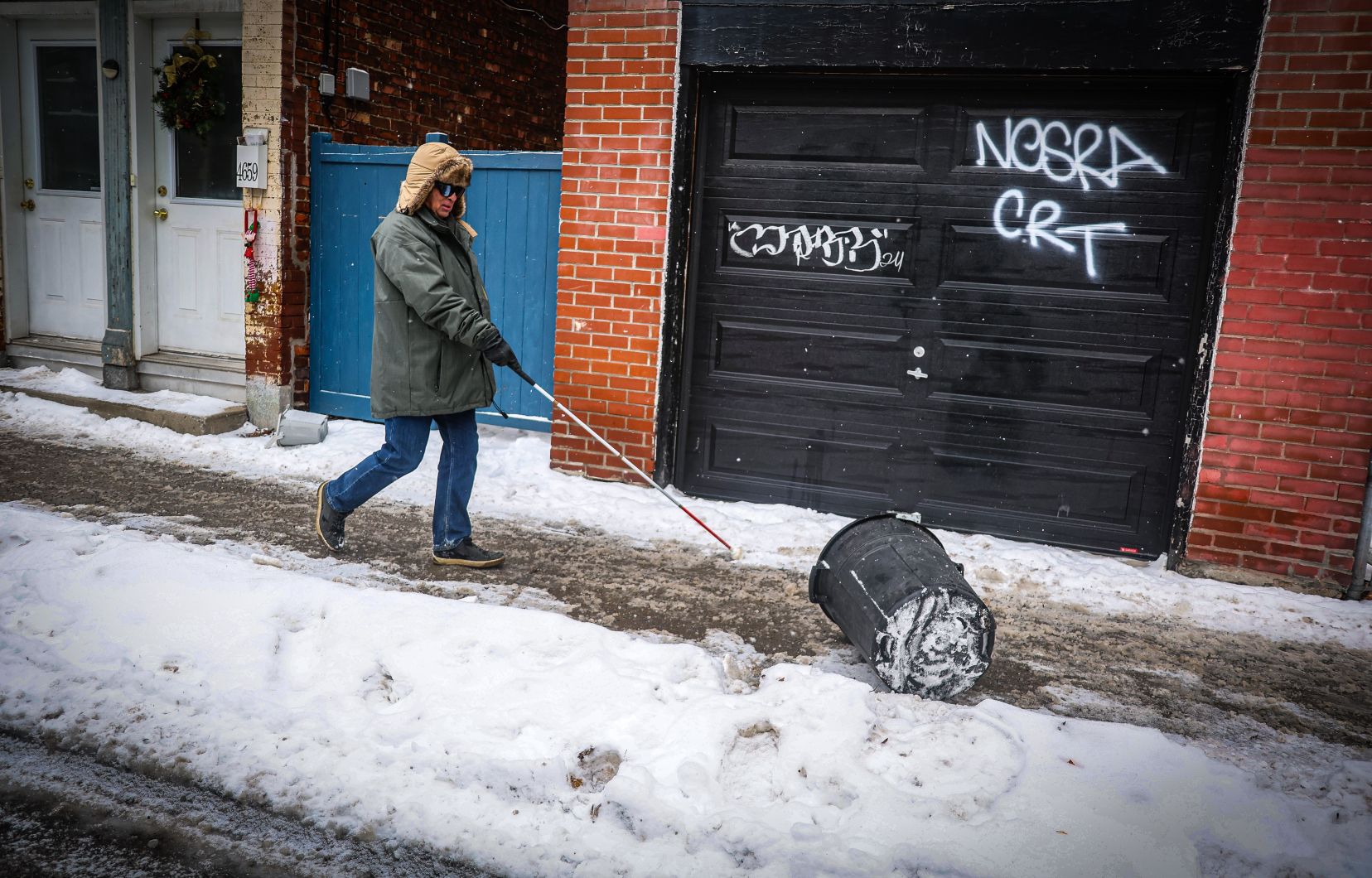
A few years ago, Yves-Marie Lefebvre, blind, took the metro in the wrong direction to Vendôme. He is forced to descend into the Villa-Maria subway, which he does not know, proceeds to the platform for modern sculptures that borders him with him. When he gropped these structures of his cane, he tries to avoid them, falls on the rails and smashes the elbow. It is a metro driver who comes in the opposite direction that delects the rails and fate there.
This incident reveals the real danger that blind people are running and more generally disabled in the public space of Montreal.
In winter, Yves-Marie Lefebvre will not work unless you are accompanied. In the summer, the sidewalks are not snowy, but its trips remain at risk if you do not cover in places that know it very well. He does not see the color of light and cannot ensure that he walks through the street in a straight line. There is no sound leash that would allow him to orient himself. “Today, I’m happy, I’m going, but I wouldn’t work alone because there is snow,” he said.
Five years ago he became completely blind, after receiving more corneal transplants. Because he has already seen, he can still rely on his visual memory at the age of 65. “But for someone who does not have this capacity for analysis, it is exclusion, social isolation,” he says.
Obligation In January, he did an exercise, followed by the streets of his Plateau-Mont-Royal district. When he proceeded with his wand, the inverted basket in the middle of the sidewalk would cause him to fall if we did not belong to him.
The activist, called on the installation of sound fires in several streets in his neighborhood, especially for safe access to the bus stops. The process that requires time requires the city to analyze experts at each request. According to his evaluation, “nine out of ten sound fires do not work” in Montreal, while the expertise on this topic is insufficient in the city.
The building where it lives is accessible by a high step and staircase. When he accepts friends who are in a wheelchair, he has to join outside, at the door.
A suitable bond transmission
Maude Massicotte, 33, is another of those warriors who risk outside their home despite their handicap in winter. It opens the door with a smile. The Director of the Defphys Organization, which she forgot, must go to a meeting of female groups in Montreal that just launched a message Go with us!about sustainable mobility of women with disabilities. To this end, she reserved the day before a suitable transport and left a note that would come and get it back in the back, in the ice aisle, because there is no ramp in front of her house. She hopes that communication came well because she couldn’t communicate directly with the driver. But the right is happening in the back. Subsequently, the driver gets another client before leaving for the finish.
After he lacked oxygen at birth, he has a brain paralysis that affects his four members. His hand cannot only understand a glass of water. From the age of six months she followed therapy to overcome her language problems.
Suitable transport is controlled by Montreal Transport Company (STM), a solution that also has a danger. STM favors traveling for health care and work. Then come free time. “One day I wanted to go to the theater,” says Maude Massicotte. I arrived late for appropriate transport and they didn’t let me enter. I had to wait all the time the room to get the right transport back to get me. And any cancellation causes points to lose in the user file. In this context, conciliation is a permanent puzzle in the field of work-family-life.
Be dependent on food
Maude Massicotte needs helping and preparing meals. When she lived alone, she was entitled to 10 hours. Because she has moved with her husband, she now gets only 8, which makes her depend on her husband as a close carer and places her in the situation of vulnerability. “I’m dependent on my husband to eat,” he says. He also condemns the fact that her body care is provided by men (also uncomfortable) and that participants often come late in appointment. “It’s complicated because I start working at nine o’clock.” »»
Maude Massicotte filed a complaint in the office of the Commissioner’s complaint and quality of CIUSS services in Est-de-l’île-de-montéal to protest in particular against shortening hours. “If it does not work, I will file a complaint about the protection of the citizen,” he says.
Pascale Thérien lived with motor problems and suffered for several years. “I worked as a recipient’s service,” she said, “and thanks to my work my health deteriorated. It is often based on a rod or pedestrians, but is afraid of prospects to face slits and unevenness on sidewalks. “Bus, we forget about it because of instability.” I’m afraid of falling and injury. People often do not leave places that are intended for pregnant, disabled, etc. The steps that lead to the subway have also scared him. When she was finally accepted to have access to the transport adapted to the other evaluation, she was able to see her mother herself. “She got me in my arms and I told her,” I went “,” he says.

Leave a Reply