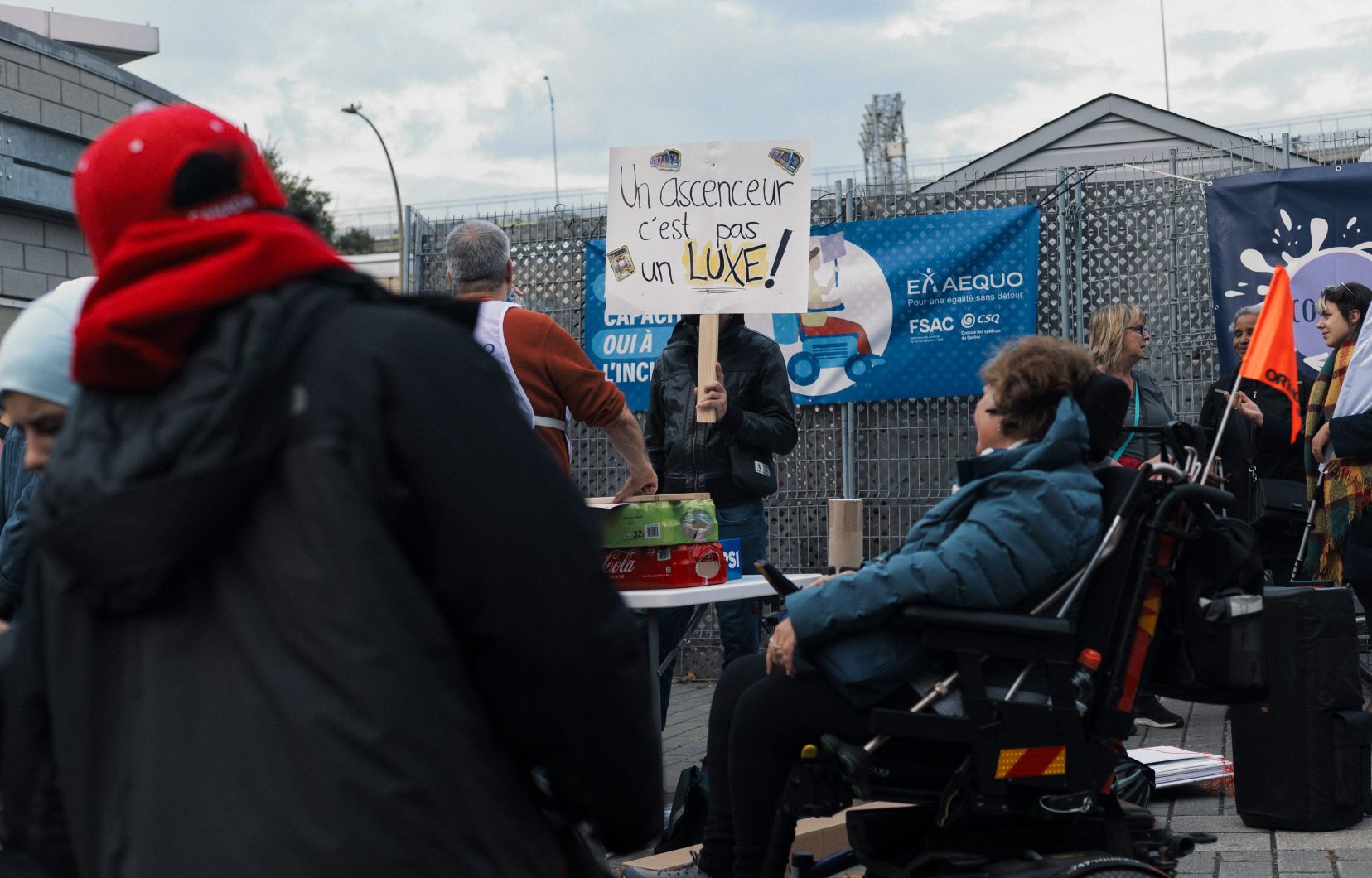
Montreal circulation is dangerous for people with disabilities. The new report from the Montreal group of female groups emphasizes the feeling of permanent uncertainty that women with disabilities experience when they leave their home.
“I never feel safe in public space,” he sums up a participant in action research Go with us!.
Every trip is quickly becoming an obstacle course for women with disabilities. You have to dare sidewalks and frozen streets, as well as the absence of access ramps, dangerous behavior of motorists, poorly designed city spots and urban development, not to mention the street harassment. According to the testimony collected in the report, regular public transport is often considered to be non -existence and inaccessible.
Laurence Parent Beautiful as Vice President on Montreal Transport Company (STM), acknowledges this: It is the installation of lifts at Montreal metro stations, which is a more urgent file in terms of mobility.
“In Montreal, yes, there is certainly a delay,” says the urban plateau-Mont-Royal, who circulates in a wheelchair. Plus, Montreal has winter challenges. »»
“Our enemy number one for us are steps.” The availability of the metro is our biggest challenge, ”he continues.
By comparison, the United States has been exercising the Accessibility Act since 1990, which has a “relatively specific impact on society, infrastructure and all. In the United States, in a wheelchair, I am much easier to circulate ”.
Often inaccessible metro
Currently, 29 out of 68 Montreal Metro has an elevator. It’s less than half. In the coming weeks, a new lift in the Atwater subway should be accessible. StM plans to open two more, in the coming years: one in Berri-Uqam on a yellow line and one at the Édouard-Montpetit station. Then nothing for the lack of budget.
Some stations were reconstructed without deciding to install elevators: this is, for example, the case of Beaubien or Saint-Michel station. “Most of the stations have not been designed to accept lifts,” explains Amelie Régis, corporate councilors at STM. Their installation may require a main job or enlargement.
At Beaubien, despite recent work, the cramped land was hired by the installation of the elevator. At Saint-Michel, the lack of funding did not allow the installation of the elevator, despite the big works. This shortcoming was the subject of the petition of the Saint-Michelois-Perrault Citizens’ Mobilization Committee, last March.
“The Saint-Michel population uses more public transport, with a measure of 41.4 %, compared to the Montreal island, which is 34.5 %. In this district, which is one of the most disadvantaged in Montreal, the availability of available public transport is a necessity for people who have fewer cars than in other neighborhoods, ”she was read in this petition.
In fact, a third party (33 %) of people with disabilities has an annual income of less than $ 15,000, according to data from persons with disabilities Du Quebec.
Rigid appropriate transmission
It is a suitable transport, secured by STM, which corrects public transport problems and ensures rare trips to several, especially in winter. But it’s not even flawless. It must be reserved for 24 hours in advance, which excludes any emergency movement, especially in the case of domestic violence. Despite this, late cancellation is recorded in the customer file. When the cancellation is repeated, customers receive a postal warning. This letter creates a shock because they are afraid of losing this service, which is especially necessary for them for movement during the winter is explained in Go with us!. The number of people authorized to support appropriate transport clients is limited depending on the evaluation of the severity of the handicap, which is problematic to people who have to circulate with the family.
It is as if transport companies could not imagine that a person with disabilities could have a blind child, a blind child, in the report. “But the world has evolved.” People who have restrictions have the right to be parents. So, something has to be done to adapt us, ”he asks.
“We are people like you who want to be part of the solution,” says Pascale Thérien, who has lived with motor difficulties for several years.
Delays are common and the driver often has to get other customers without warning, so arrival time random. Clients are mixed and intellectual deficits, for example, bother or defend with the lack of engine. Customers must be limited to two bags and generally cannot use them to produce food trade.
“I have taken the appropriate transport for a long time and as it exists, it requires a lot of planning.” It is certain that there are challenges, says Laurence Parent, Vice -Chairman of the Board of Directors of STM. All problematic situations are taken seriously. Therefore, we want to meet a table of female groups and see what we can do to make the right suitable. There are more specific problems for women that we talked about less before. But I also note that drivers’ training has generally improved a lot. »»
The urban landscape out of transport is often not designed to conceive people with disabilities. Yves-Marie Lefebvre, blind, notes that instead of des Fleurs-de-Macadam, on Mont-Royal, it has been literally flooded with prices since its creation. However, it is simply not accessible to people with disabilities, because the entry does not appear there in the direct line.
At the intersections of the streets, pedestrian crossing time is considered too fast and remains the same in every season. “Sometimes it’s 15 seconds, sometimes 25,” says Pascale Thérien, who also participated in action research.
It’s chaos on the street. “Motorists mislead the time to exceed, do not respect the speed limits and arrive very quickly at the intersection, interrupt the passage to the person who crosses, approach them while landing a bus or suitable transport, taxi, car or sharing and not stop at crossbides pedestrians “Summarizes Ambannel Claire, which moves in a motorized chair, and estimates that motorists suffer from“ disability of ignorance ”.
They are also motorists who are perceived as uncertain, followed by cyclists, then police and pedestrians, respondents of action research.

Leave a Reply